That First Sip Feeling (And Why It's Not Always There)
You know that moment. You've ground fresh beans. Boiled the kettle. Done everything right — and the first sip is just... flat. Or sharp. Or so bitter it makes you wince. The mug goes down. The morning dims slightly.
That disappointment isn't random, and it isn't your fault. It's chemistry.
Every time water meets coffee — whether that's in your cafetière on a Tuesday morning or an espresso machine at your favourite spot in town — an invisible process called coffee extraction is underway. It determines whether your cup tastes like a sun-dried Ethiopian Yirgacheffe at its sparkling best. Or like something left too long on a motorway services hotplate.
Coffee extraction is the process by which water pulls flavour compounds out of ground coffee. Get it right, and you have a balanced, complex cup. Get it wrong, and you've got a sour, thin brew. Or a bitter, harsh one.
The good news is, a little bit of chemistry goes a long way.
What Exactly Is Coffee Extraction?
Think of a roasted coffee bean as a tiny, densely packed warehouse. Inside, there are hundreds of different chemical compounds. We can see: aromatics, acids, sugars, and bitter molecules. All locked within a rigid cellular structure called the coffee matrix. Your job, as the brewer, is to send water in there and collect the good stuff.
That's extraction, in plain terms - a process of dissolving. Water is the solvent. The soluble compounds in the coffee matrix are the target. When water moves through your grounds, it picks up those compounds and carries them into your cup.
Here's the crucial bit, though — not everything in coffee can dissolve. Cellulose, the woody structural material that gives the bean its physical form, stays behind. That's fine. You weren’t drinking it.
But here's where it gets interesting. Not everything that can dissolve should dissolve — at least, not all at once. A roasted coffee bean contains roughly 30% soluble material by dry weight. Dissolve too little, and the cup is empty and sharp. Dissolve too much, and it turns harsh and drying.
The secret lies in the order in which those compounds are released from the bean. And this order is not accidental at all.
The Chemistry Behind the Cup — What Water Actually Pulls Out
Water doesn't grab everything at once. It works through the coffee matrix in waves, pulling out different families of compounds at different rates. Imagine it less like a flood and more like a carefully (if unconsciously) timed relay race. The question is whether your brew catches all three legs of that race — or stops too early, or runs too long.
Acids First — Brightness and Fruitiness
The first compounds to dissolve are the acids — primarily chlorogenic acids and acetic acid derivatives. These are the molecules responsible for that bright, lively quality in a good cup: the blueberry note in a washed Kenyan, the citrus snap in a light-roasted Colombian.
In the right proportion, they're wonderful. They give coffee its vibrancy and lift. But if your brew stops here — because the water moved too fast, or the grind was too coarse — acids are all you get. The result is a hollow, sharp sourness that makes you check whether the milk has turned.
Sugars and Caramelised Compounds — The Sweet Spot
Next to arrive are the caramelised sugars and Maillard reaction products — the same family of browning compounds responsible for the crust on a good sourdough or the complexity of a slow-cooked stew. These carry sweetness, body, and the layered flavour notes that make a well-brewed cup genuinely interesting.
This is the middle third of extraction, and it's what every brewer is quietly chasing. Hit it well, and your coffee has roundness, depth, and that quality that's hard to name but immediately recognisable.
Bitter Compounds — The Overstay
Last out are the caffeine, phenolic acids, and high-molecular-weight melanoidins — large, slow-moving molecules that require sustained contact with water to dissolve. A small amount contributes to the structure and that pleasant, clean bitterness in a well-made espresso. Too much, and the cup turns astringent, drying, and flat.
So the chemistry is clear: balance across all three families is the goal. But how do you actually measure whether you've hit it?
Extraction Yield — The Number That Explains Everything
We already know that water pulls compounds out sequentially, and that balance across all three families is the goal. But is there a way to know, with any precision, whether your brew has actually landed in that sweet spot?
Yes, it's called extraction yield — the number - the speciality coffee world quietly obsesses over.
Extraction yield expresses, as a percentage, how much of your dry coffee has already dissolved into the water. If you brew with 15 grams of ground coffee and 1.5 grams of that ends up in your cup as dissolved solids, your extraction yield is 10%. Too low. If 3.6 grams dissolved, you're at 24%. Too high.
The Speciality Coffee Association recommends a target range of around 18–22%. Within that band, you're statistically likely to have pulled enough of the sweet, complex middle compounds without tipping into the bitter, astringent late ones.
How to calculate the Extraction Yield?
In a professional setting, baristas use a refractometer. A small device that measures how light bends through the brewed coffee, providing a reading called TDS (total dissolved solids). From that, combined with your brew ratio, you can calculate the extraction yield to one decimal place.
It sounds fussy. Honestly, for home brewing, it largely is. Refractometers are useful diagnostic tools, but they're not the point.
The point is this: your palate already knows. A sour, thin cup is whispering "low extraction yield." A harsh, drying cup means the yield was too high. The number just gives that instinct a language.
Understanding extraction yield means trusting what you taste — and knowing exactly which direction to move when something's off.
Which brings us to the two most common ways things go wrong.
Under-Extraction vs Over-Extraction — What Can Go Wrong?
Most bad cups of coffee aren't a mystery. They're the result of one of two factors. When you can tell them apart, you've got genuine diagnostic power over your brew.
Under-extracted Coffee — Sour, Thin, Hollow
You'll know under-extraction by its sharp, almost aggressive sourness. Not the pleasant brightness of a well-made Ethiopian filter, but something more like lemon pith. There's a distinct lack of sweetness, a watery body that doesn't linger, and a finish that drops away almost immediately.
What's happened chemically is straightforward. The water moved through the coffee too quickly. The contact time was too short. The caramelised sugars and Maillard compounds, which sit deeper in the extraction sequence, couldn’t be reached. You've essentially collected the first act and left the rest of the performance running without an audience.
Common causes of that: the grind was too coarse, the water was too cool, or brewing time was too short. Solvable, all of them.
Over-extracted Coffee — Bitter, Drying, Flat
Over-extraction feels different. The bitterness here isn't clean. It's the kind that coats the back of your tongue and stays. There's a drying, almost chalky sensation on the palate. Despite the intensity, the cup tastes oddly one-dimensional. Like someone turned the volume up but removed all the interesting frequencies.
The chemistry is simple. Water has been in contact with the grounds long enough to dissolve the high-molecular-weight melanoidins and excess phenolic acids. Those are the late-stage compounds that contribute structure in small amounts, but dominate unpleasantly in large amounts. The sweet middle compounds are still there, but they're buried.
Common sources are: too fine a grind of coffee, too hot water, or too long a brewing time.
Neither of these is a verdict on your coffee brewing skills. This is data. Now that you can read them, you just need to know which variables to take.
The Four Variables That Control Your Extraction
Here's the genuinely good news. Despite all the chemistry happening inside your brew, there are really only four factors you need to understand to take control of it. Pull any one of them in a predictable direction, and the chemistry follows.
Grind Size — The Surface Area Equation
Think about how a sugar cube dissolves in tea versus granulated sugar. Same mass, same water, same temperature — but the granulated sugar disappears far faster because it presents so much more surface area to the water.
Coffee works identically. Finer grinding increases surface area. The water has more points of contact with the coffee matrix, accelerating extraction across all compound families. Coarser grinding reduces the surface area, slowing the process down.
This is why grind size is usually the first thing to adjust when a coffee tastes off. It's the most direct dial you have over the extraction rate — and it responds predictably every time.
Water Temperature — The Kinetic Energy Factor
Hotter water carries more kinetic energy, which means its molecules move faster and dissolve compounds more readily. That sounds straightforwardly good. But it isn't. The higher temperatures accelerate the extraction of all compounds, including the bitter late-stage ones.
The practical sweet spot for most brewing is 90–96°C. At this range, you're dissolving the bright acids and sweet Maillard compounds efficiently without aggressively chasing the phenolics and melanoidins that follow.
Brew Time — The Clock Is Always Running
From the moment water meets coffee, extraction begins. Every additional second shifts the balance incrementally toward the later, more bitter compounds. Different brewing methods are, in essence, just different strategies for managing this clock — a 25-second espresso versus a 4-minute cafetière versus a 3-minute AeroPress are all working the same chemistry at different speeds and pressures.
If your cup is consistently over-extracted, shortening contact time is often the simplest fix before touching anything else.
Coffee-to-Water Ratio — Strength Is Not the Same as Extraction
Extraction is about what percentage of the coffee has dissolved. Strength is about how concentrated the resulting drink is. If you use 20 grams of coffee instead of 15 grams but keep everything else identical, you haven't extracted more — you've just produced a stronger cup at roughly the same extraction level. The ratio shifts concentration, not the chemistry of dissolution.
This matters practically: if your espresso tastes weak, the instinct to add more coffee may not solve the problem. The real question is whether your extraction yield is in the right window first.
These four variables don't operate in isolation — they interact. But here's the thing: they interact differently depending on the brewing method you have chosen.
How Different Brew Methods Change the Extraction Chemistry
Every brew method is just a different set of decisions about those four variables. Each one produces a chemically distinct cup of coffee as a result. There's no single correct approach. There's just the expression you're after.
Espresso — High Pressure, Short Time, Fine Grind
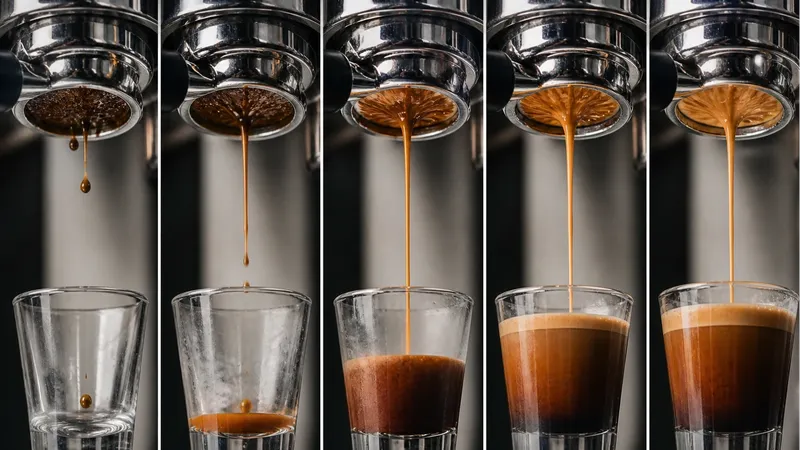
Espresso introduces a fifth variable that home filter brewing doesn't have: pressure. At 9 bars, water is forced through an extremely fine, densely packed puck of coffee in 25–30 seconds. That pressure dramatically accelerates the dissolution of soluble compounds, which is how you extract a concentrated, complex shot in less time than it takes to butter toast.
It's also why espresso is so unforgiving. Every variable is operating at an extreme — fine grind, high pressure, short window. A half-notch on the grinder in the wrong direction and the whole chemical balance shifts noticeably.
Cafetière — Low Tech, Long Contact, Coarse Grind
The cafetière is an immersion method. Coffee is in water for the full brew time (typically 4 minutes), rather than passing through it. Time is the primary extraction factor here, and the coarse grind keeps the rate manageable.
That characteristic full body comes partly from something that filter methods actively remove. The fine particles and coffee oils pass straight through the metal mesh. They're not dissolved compounds — but they contribute texture and perceived richness.
Filter / Pour-Over — Controlled Flow, Clean Cup
Pour-over is a percolation method. Fresh water continuously moves through the grounds, taking dissolved compounds with it and constantly presenting new solvent to the coffee matrix. It gives the brewer precise control over flow rate and contact time. Plus, it makes a cleaner, more transparent cup of coffee. This is exactly why speciality roasters tend to favour it for showcasing origin character.
AeroPress — The Variable Wild Card
The AeroPress is usefully strange. It can be brewed with light manual pressure and a short steep time (closer to espresso making) or slow and cool using an extended contact time (closer to filtered brewing). That flexibility makes it genuinely difficult to pigeonhole — and a brilliant tool for understanding how each variable affects the cup of coffee independently.
Despite these different methods, all four are pursuing the same core chemistry. Before brewing, however, one more factor plays a crucial role: the roast.
Does Roast Level Affect Extraction?
Significantly — and in ways that aren't always obvious.
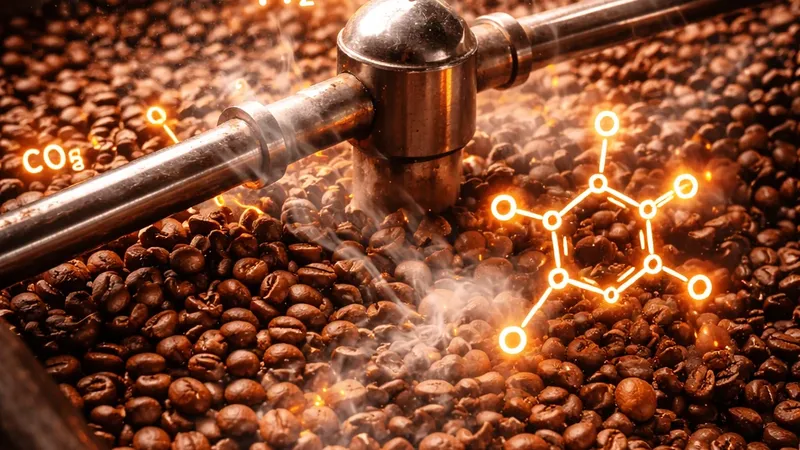
Roasting is essentially a controlled application of heat that drives off moisture, triggers the Maillard reaction, and causes the bean's cellular structure to expand and become increasingly porous. The darker the roast, the more that structure has broken down. Darker roasted beans extract faster because water can penetrate the matrix more easily — there's simply less physical resistance.
Lighter roasts are denser. The cellular structure is more intact. This means water needs more energy and time to access the soluble compounds inside. Use the same recipe with a light-roast single origin as you would on a dark Italian-style espresso blend, and you'll likely under-extract it — producing that sour, hollow result that sometimes puts people off lighter coffees entirely.
Here's the subtler point. The common assumption that dark roast equals bitter isn't purely about roast flavour. Darker roasted beans have already developed more bitter phenolic compounds during the roasting process itself — so they arrive at the brew with a higher baseline of late-stage compounds. Over-extract a dark roast even slightly, and those compounds dominate quickly. However, the roast level is set before the coffee reaches you.
The next important variable, one that's surprisingly within your control , is the water you're brewing with.
The Unsung Variable — Your Water
Most people don't think of water as an ingredient, but it is.
Water is your solvent. Dissolved minerals directly affect how efficiently it extracts ingredients. Magnesium, in particular, has a strong affinity for the aromatic and flavour compounds in coffee, actively helping to pull them into solution. Calcium contributes to overall extraction efficiency and the perceived body.
Too little of both (as in the naturally soft water common across parts of Scotland and Wales), and your water cannot extract fully, producing a flat, muted cup regardless of how well you've dialled in everything else. Conversely, very hard water (common in South East England) can interfere with extraction and leave a chalky aftertaste.
Speciality cafés use precisely mineralised filtered water for exactly this reason. At home, a simple filtered jug won't provide you with laboratory-quality control. In hard or soft water areas, it can make a little noticeable difference.
Now you have the full picture of the process.
You Already Knew More Than You Thought
Here's what's worth sitting with. Every time you've winced at a bitter espresso, or pushed away a sour pour-over, or thought something's not right here, you were already reading the chemistry.
That sourness was under-extraction talking. That drying bitterness was over-extraction. That flat, muted cafetière was caused by soft water with a small amount of magnesium.
None of this requires a refractometer, a chemistry degree, or a particularly serious relationship with a set of scales. It requires curiosity, a willingness to adjust one variable at a time, and the confidence to trust what your palate is already telling you.
Coffee extraction isn't a problem to solve once and forget. It's an ongoing, genuinely enjoyable conversation between you and your brew.
This article is for informational and educational purposes only and does not constitute medical or professional advice. Please read our full Disclaimer for more information.
Frequently Asked Questions
Coffee extraction is the process of dissolving flavour compounds from roasted, ground coffee into water. Every time you brew — whether that's a cafetière on a Sunday morning or an espresso at your local — extraction is happening. Water acts as a solvent, pulling out acids, sugars, and bitter compounds in sequence. Get the balance right, and you've got a complex, satisfying cup. Get it wrong, and you're either in sour or bitter territory.
The Speciality Coffee Association puts the sweet spot at 18–22% extraction yield. It means 18–22% of your dry coffee's mass has dissolved into the water. Below that, you're under-extracted, expect sourness and a thin body. Above it, over-extracted, expect bitterness and a drying finish. That said, your palate is a perfectly reliable instrument. A balanced, pleasant cup is the real target — the percentage is just a useful map, not the destination.
Under-extracted coffee tastes sharp and sour (like lemon pith rather than bright citrus), with a watery body and no lingering sweetness. Over-extracted coffee goes the other way. A heavy, coating bitterness that dries out the back of your tongue and flattens everything else. If your filter coffee tastes dry, grind the coffee beans finer or brew it longer. If your espresso is unpleasantly sharp, grind the coffee beans coarser or shorten the shot time.
Absolutely — grind size is one of the most direct controls you have over the extraction process. A finer grind increases the surface area exposed to water, which accelerates the dissolution of compounds. A coarser grind slows things down. Think of it like granulated sugar versus a sugar cube: same mass, very different dissolution rate. If your cafetière tastes sour and thin, try grinding slightly finer before adjusting anything else. It's usually the quickest fix.
More than most people realise. Water isn't just a carrier. It's an active solvent, and its mineral content matters. Magnesium, in particular, has a strong affinity for coffee's aromatic compounds, helping pull them into solution. Very soft water (common in parts of Scotland and Wales) often produces flat, muted cups regardless of your recipe. Very hard water (commonly found in South East England) can interfere with extraction clarity. A simple filtered jug can make a quiet but genuine difference.