That First Sniff Isn't an Accident
Imagine this. It's early morning. You've barely managed to locate your own shoes, let alone form a coherent sentence. But the moment you open a fresh bag of roasted coffee, something shifts. That smell — dark, sweet, toasty, almost nutty — reaches you before the kettle even boils, and suddenly you feel marginally more human.
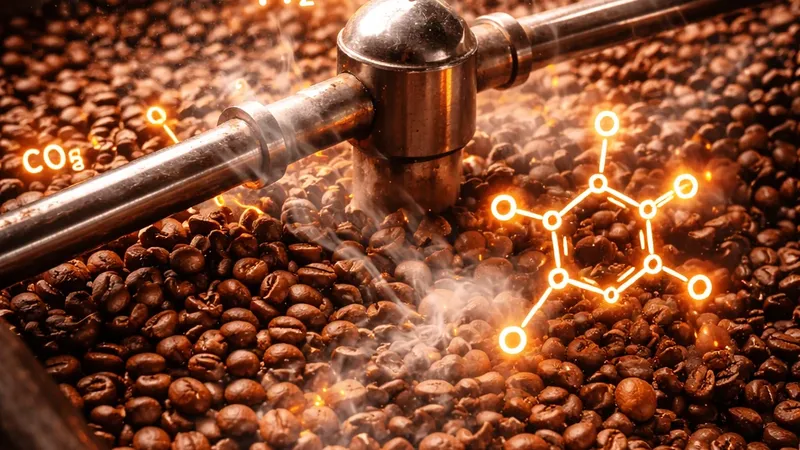
That aroma isn't an accident. It isn't magic, either, though it can feel that way. It's the result of a cascade of chemical reactions that happen at precise temperatures during roasting. Reactions that transform a small, waxy, straw-coloured green bean into something complex, beautiful, and deeply satisfying.
The reaction at the heart of it all has a rather grand name: the Maillard reaction. It's named after the French physician and chemist Louis-Camille Maillard, who first described it in 1912. More than a century later, it's still one of the most fascinating and consequential reactions in all of food science.
You don't need a chemistry degree to understand it — promise. What you do need is a decent cup of coffee and five minutes. Let's talk through what's actually happening inside those beans.
So, What Is the Maillard Reaction?
At its most fundamental. The Maillard reaction is a chemical interaction. It's between two types of molecules found naturally in food: amino acids (the building blocks of proteins) and reducing sugars (a category that includes glucose and fructose, among others).
When these two molecules are heated together (roughly 140–165°C as a starting point), they don't just sit there politely. They react. And in reacting, they produce hundreds of new compounds that didn't exist before. These compounds are responsible for:
- Brown colour (think: the crust on bread, the sear on a steak, the deep mahogany of a well-roasted espresso bean)
- Roasted, toasty, caramel-like aromas
- Complex, layered flavours that range from nutty and chocolatey to fruity and floral (depending on what's in the mix)
What makes the Maillard reaction particularly brilliant, and a bit mind-bending. Doesn't it produce just one new molecule? It produces somewhere in the region of hundreds to thousands of different flavours and aroma compounds. All are from the same basic starting ingredients. The specific compounds that form depend on temperature, time, humidity, pH, and the particular amino acids and sugars involved.
This is why "roasted coffee" isn't just one flavour. It's a symphony.
And this is why understanding the Maillard reaction in coffee chemistry is, genuinely, one of the most useful things a coffee lover can do.
The Maillard Reaction in Coffee Beans — What's Actually in There?
Not all foods produce the same Maillard results. A plain potato, a piece of chicken breast, a slice of sourdough. They all undergo Maillard browning when cooked, but they don't produce the same flavours. The reason is simple: it depends on what's in the food to begin with.
Green coffee beans are, from a chemist's point of view, a rather extraordinary starting material.
Sugars in green coffee beans
A typical Arabica green bean contains around 6–9% sucrose by dry weight. A fairly high amount for something that doesn't taste remotely sweet in its raw state. There are also smaller quantities of glucose, fructose, and other reducing sugars. During roasting, some of this sucrose is hydrolysed (broken down) into glucose and fructose. It occurs before the Maillard reaction even begins properly.
Robusta beans contain noticeably less sucrose (roughly 3–7%). This is one of the reasons they tend to roast up with a harsher, earthier profile. Less sugar going in means a different flavour balance coming out.
Amino acids in green coffee beans
Green beans contain free amino acids. Particularly, alanine, asparagine, leucine, proline, and several others, as well as proteins. The specific mix of amino acids matters enormously. Those different compounds react with sugars to produce different flavour compounds. Proline, for instance, tends to produce roasted, bread-like notes.
Why the origin affects what the Maillard reaction produces
A coffee grown at high altitude in Ethiopia will have a different amino acid and sugar profile than one grown at a lower altitude in Brazil. The variety, soil composition, altitude, rainfall, and post-harvest processing - all of them influence the raw chemistry of the green coffee bean. This is part of why single-origin coffees taste so distinct. They arrive at the roaster with a unique chemical fingerprint. The Maillard reaction expresses that fingerprint differently each time.
Washed coffee beans (where the fruit is removed before drying) tend to have a cleaner, brighter cup in part. The beans don't absorb extra sugars and compounds from the coffee cherry during processing. Natural-processed coffees (left to dry inside the fruit) pick up more fermentation-derived compounds and sugars. This gives the Maillard reaction more to work with and often produces fruitier, wine-like cups.
The Maillard Reaction in Coffee Roasting — A Timeline
Roasting a coffee bean is, in broad strokes, a process of applying controlled heat to transform raw chemistry into drinkable pleasure. The Maillard reaction doesn't switch on all at once. It builds gradually, overlapping with other reactions as the temperature climbs.
Here's a rough timeline of what's happening inside the drum (or pan, or oven — however you're roasting):
Stage 1: Drying (ambient to ~150°C)
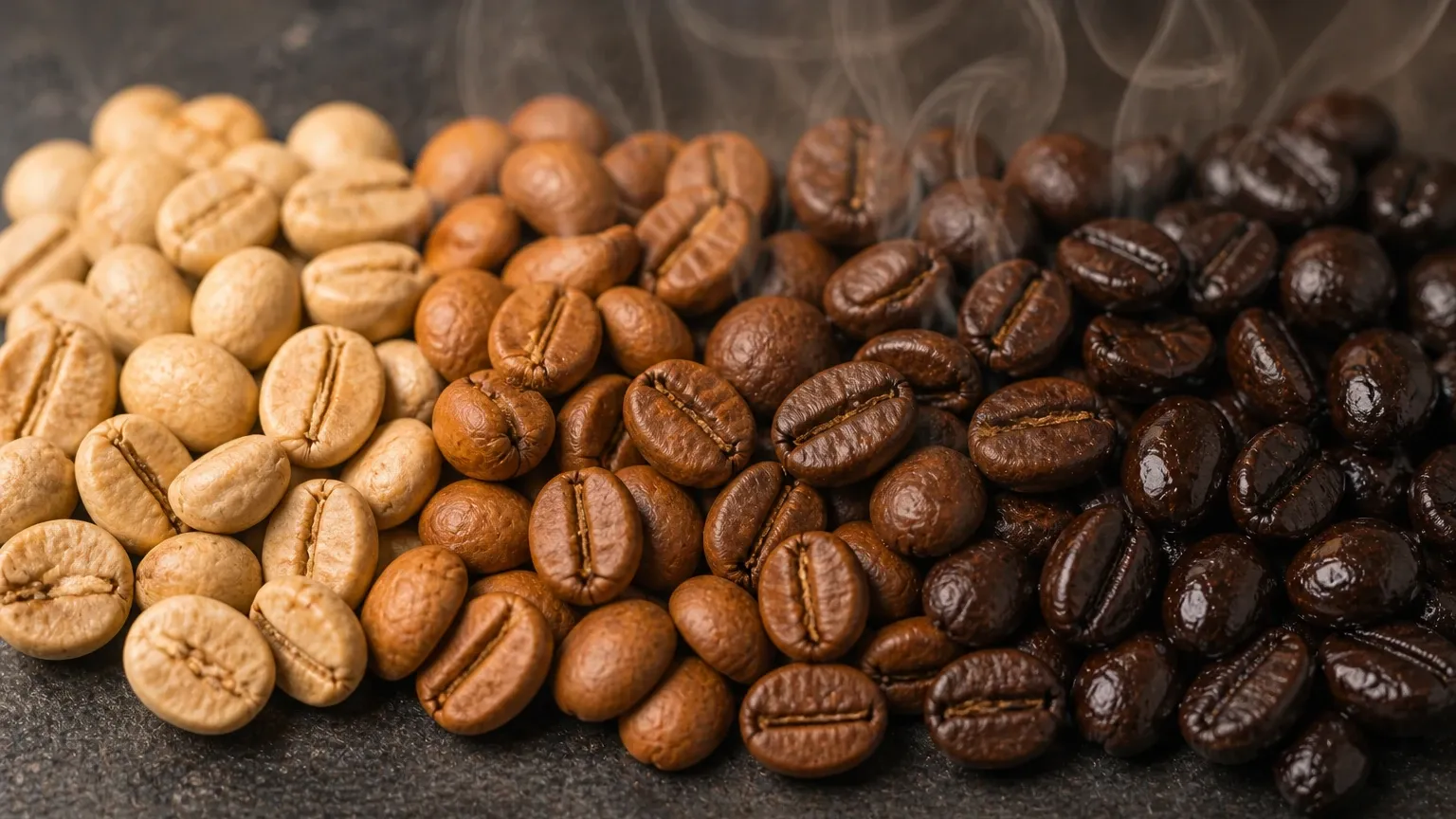
Green beans contain significant moisture (around 10–12% water by weight). In the early stages of roasting, most of the energy is used to evaporate this water. The beans turn from grey-green to yellow as moisture loss continues. The Maillard reaction begins at the lower end of this range, but it's slow and tentative. The aromas at this stage are grassy, hay-like — not yet what you'd call "coffee."
Stage 2: Yellowing to Light Brown (~150–170°C)
Here's where things get interesting. As the bean surface temperature rises and moisture drops, the Maillard reaction accelerates. Amino acids and reducing sugars begin reacting in earnest. You'll notice the colour shifting from yellow to a pale tan. The aromas are becoming more bread-like, slightly nutty.
This is also when caramelisation begins — a separate but related process involving only sugars. Caramelisation produces its own distinctive, sweet, toffee-like compounds. In roasting, Maillard reactions and caramelisation often happen simultaneously. They interact with each other, making the chemistry particularly complex.
Stage 3: First Crack (~196–204°C)
One of the most satisfying moments in roasting. As the bean's internal pressure builds from CO₂ and steam, it ruptures — producing an audible crack. A bit like popcorn popping. At this point, the Maillard reaction is in full swing. Hundreds of flavour compounds are forming rapidly. The bean colour is moving from cinnamon to light brown.
Roasters who stop here (or just after) produce lighter roasts — bright, acidic, often fruity or floral. With the Maillard-derived complexity still relatively delicate and the bean's origin character prominent.
Stage 4: Development Time (post first crack)
The period after the first crack is called "development time". It's where the roaster has the most control. Extending development allows more Maillard reactions to occur and complete, deepening flavour and colour. Push too hard or too fast, and you risk moving into pyrolysis. Those are the breakdown of carbon compounds at very high temperatures. They produce the bitter, ashy notes associated with over-roasted or burnt coffee.
Stage 5: Second Crack (~224°C and beyond)
At the second crack, the cell walls of the bean begin to (physically) break down. The coffee is now firmly in dark roast territory. The Maillard-derived flavours are still present. But they're increasingly masked by pyrolysis compounds — smoky, bitter, almost tarry. The bean's original character is largely gone at this point.
This is why roast level matters so profoundly. It's not just about "strength." It's about where along the Maillard reaction's arc you've chosen to stop.
What Does the Maillard Reaction Actually Taste Like in Your Cup?
The whole of this chemistry is well and good. But what does it actually mean when you're standing over your cafetiere on a Tuesday morning?
Rather a lot, as it turns out.
The Maillard reaction in coffee chemistry produces a vast library of flavour-active compounds. Food chemists have identified well over 800 volatile compounds in roasted coffee. The largest of any single food product, as far as we currently know. Not all of them are pleasant, and are present in meaningful quantities in every cup. But the ones that form the backbone of everything you love about coffee.
Here are some of the main flavour families and their Maillard origins:
Caramel and toffee notes are produced largely by interactions between sugars and amino acids at moderate temperatures. The compounds responsible for this state of affairs include furanones and diacetyl. If your coffee tastes like brown sugar, toffee, or golden syrup, you're tasting Maillard chemistry at work.
Chocolate and cocoa notes come from Pyrazines. A family of nitrogen-containing compounds formed during Maillard reactions. Well-developed medium roast beans often taste similar to dark chocolate or cocoa. The Maillard reaction has produced abundant pyrazines without yet destroying them through over-roasting.
Nutty and toasty notes are particularly prominent in medium roasts. These originate from a range of Maillard products, including furans and pyrroles. Think hazelnut, almond, toasted bread.
Fruity and floral notes are more surprising but equally important. Some Maillard compounds contribute to the brighter, more delicate end of coffee's flavour spectrum. Lighter roasts, where the Maillard reaction has been active but not prolonged, often retain fruity aldehydes and esters. These pair with the bean's natural acids to give those blueberry, cherry, or jasmine notes that speciality coffee enthusiasts seek out.
Some Maillard products are bitter, including certain melanoidins (the large, dark-brown polymers that give roasted coffee its colour and body). A degree of bitterness is desirable, even pleasant. However, pushing the roast too far, Maillard-derived bitterness compounds accumulate faster than the sweeter, more aromatic ones.
The balance between all of these is what roasters spend their careers chasing. It's genuinely skilled work.
The Maillard Reaction and Coffee Colour — Why Your Brew Looks the Way It Does
The Maillard reaction doesn't just flavour your coffee. It colours it.
The Maillard reactions proceed through their various stages. They produce large, complex, dark-brown polymer molecules called melanoidins. The name comes from the Greek "melas". It means black.
Melanoidins are among the most abundant compounds in roasted coffee. In a typical espresso, they make up a significant portion of the dissolved solids, contributing to:
Body and mouthfeel. Melanoidins are large molecules. They add viscosity and richness to brewed coffee, giving it that satisfying weight on the palate that distinguishes a well-extracted espresso from watery disappointment.
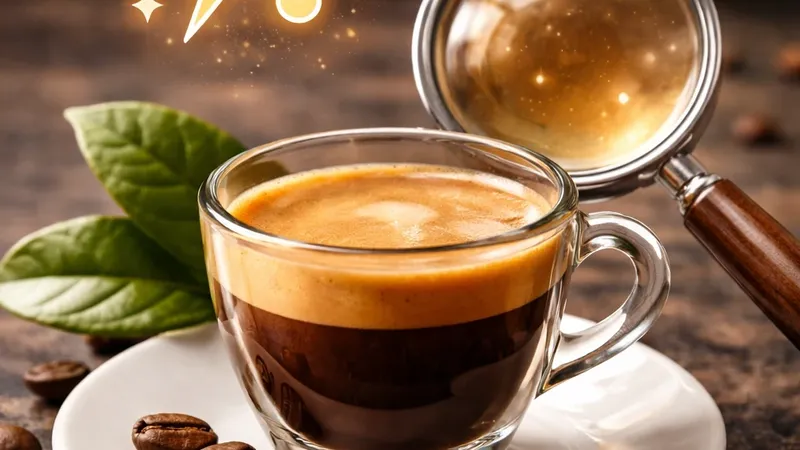
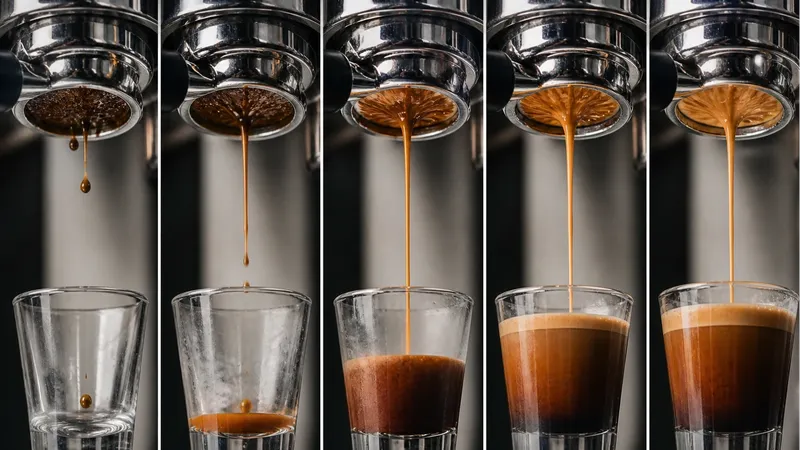
Crema. That beautiful golden-brown foam on an espresso? It's an emulsion of CO₂ bubbles stabilised partly by melanoidin compounds. The Maillard reaction is literally building your crema.
Antioxidant activity. This is an area of active research. But there's growing evidence that coffee melanoidins have antioxidant properties. This means they may help neutralise harmful free radicals in the body. Coffee, despite what anxious headlines occasionally suggest, contains a range of potentially beneficial compounds. Melanoidins are increasingly recognised as contributors to that picture.
Colour in the cup. That gorgeous deep amber in your flat white? The near-black of a long espresso? Melanoidins, all the way down.
Maillard Reaction vs Caramelisation — They're Not the Same Thing
Here's something that trips up even people who know a lot about cooking. Caramelisation and the Maillard reaction are not the same thing.
Both produce browning. Both produce complex flavours. Both happen during roasting. But they are chemically distinct processes.
| Maillard Reaction | Caramelisation | |
|---|---|---|
| Molecules involved | Amino acids + reducing sugars | Sugars only |
| Temperature onset | ~140°C (can vary) | ~160–180°C for sucrose |
| Requires protein/amino acids? | Yes | No |
| Flavour character | Savoury-roasted, complex, meaty-nutty | Sweet, buttery, toffee-like |
| Produces colour? | Yes (melanoidins) | Yes (caramel polymers) |
In coffee roasting, both happen — and they interact. The caramelisation of sucrose in the coffee bean contributes sweet, toffee-like notes. The Maillard reactions create a layer of roasted, chocolatey, and nutty complexity. Together, they generate the flavour architecture of roasted coffee.
Why does this distinction matter to you as a coffee drinker? Because it helps you understand. Why are some coffees sweeter than others (more caramelisation-derived compounds)? Why do some taste more intensely roasted (more Maillard)? And why low-sugar Robusta beans produce a different flavour balance than high-sugar Arabicas even at the same roast level.
It also means that when someone tells you "your espresso tastes caramelised," they might be reaching for the right feeling but not quite the right science. Most of what they're experiencing is the Maillard reaction.
How Roasters Use This Knowledge — And Why It Should Change How You Buy Coffee
All of this chemistry is controlled or coaxed, really, by the roaster.
A skilled roaster isn't just applying heat and hoping for the best. They're managing a careful series of decisions. How fast should the drum be charged? When to apply airflow. How quickly can we push through the yellowing phase? How long to hold development time after the first crack? Every one of these decisions shapes the Maillard reaction in coffee roasting. Which compounds form, in what concentrations, and in what balance?
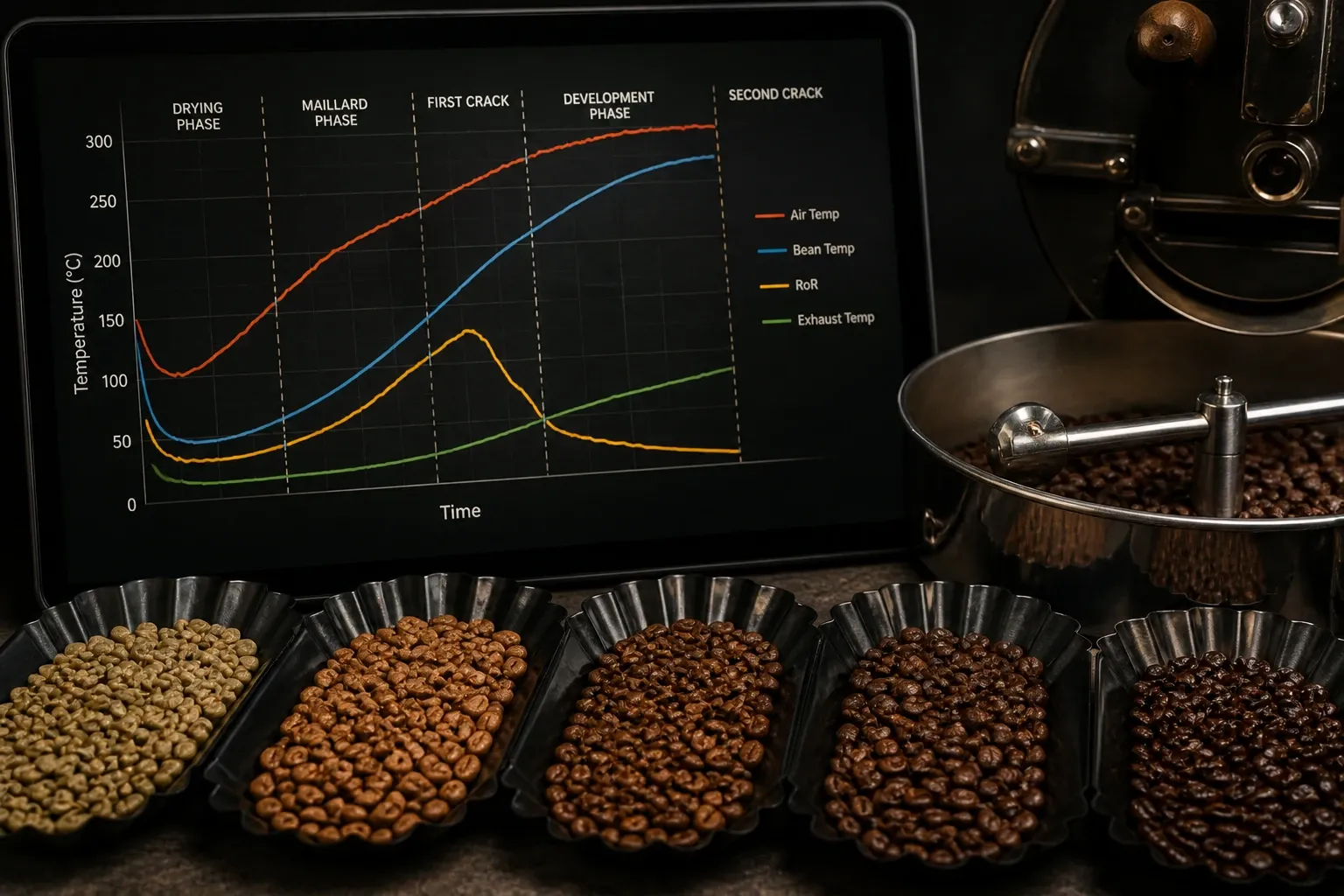
Modern roasters use detailed "roast curves". It is a graph tracking the temperature of coffee beans and the rate of rise over time. A steep rate of rise early on might rush through the Maillard phase before the full range of flavour compounds can develop. A flatter, more extended roast might allow more complete Maillard development, but risks baking the bean. A flat, papery taste that coffee professionals know all too well as a roasting fault.
The development ratio
One of the metrics roasters monitor closely is the development time ratio. The proportion of total roast time spent after the first crack. A development ratio that's too short produces underdeveloped, sour, or grassy coffee. Too long, and you're into scorching territory. Getting it right is part art, part chemistry, part deep familiarity with a particular bean's behaviour.
What this means for your next purchase
When you see a speciality roaster describe a coffee as "developed to highlight caramel sweetness and dark chocolate" or "roasted light to preserve floral aromatics," they're talking, in part, about where along the Maillard arc they've stopped.
Buying from a roaster who thinks carefully about this — and who communicates it clearly — is genuinely worth the extra pound or two per bag. Not because it's a luxury. It means someone has applied real skill and knowledge to the chemistry happening inside your beans. You taste that in the cup.
A Few Things That Affect the Maillard Reaction Beyond Temperature
Temperature is the most obvious driver of Maillard reactions, but it's not the only one. Several other factors influence the course of the chemical process. Understanding them helps to explain some of coffee's puzzling behaviours.
Water activity
The Maillard reaction slows dramatically in the presence of too much moisture. This is why the drying phase at the start of roasting is so important. Removing moisture from the grain allows the reaction to accelerate correctly. It also explains why freshly roasted coffee, stored well in a dry environment, retains its complexity better than beans left in a humid kitchen cupboard.
pH (acidity/alkalinity)
The Maillard reaction proceeds faster in slightly alkaline conditions. The natural pH of green coffee is gently acidic, but it shifts during roasting. Some processing methods (particularly extended fermentation) can affect the bean's pH before it even gets to the roaster, subtly influencing Maillard outcomes.
Time
The longer time at temperature means more Maillard products. But it's not linear. There are diminishing returns, and eventually, undesirable breakdown products form. This is why a slow roast at medium and a fast roast at high temperature can produce quite different cups even if the "final Celsius degrees" are the same.
Storage after roasting
Once roasted, coffee continues to change. Maillard-derived volatile compounds are relatively fragile. They oxidise and de-gas over time. This is why fresh-roasted coffee (typically 5–21 days post-roast, depending on brew method) tastes more vibrant than beans that have been sitting in a warehouse for six months. Degassing matters too. CO₂ produced during roasting continues to escape from the bean for days after roasting. If you brew too soon, that CO₂ can interfere with extraction.
Treat your coffee beans kindly. Store them in a hermetic container away from light and heat. Buy in small quantities from roasters who date their bags. The Maillard reaction has done extraordinary work inside those beans. The least we can do is not undo it through poor storage.
The Maillard Reaction in Your Brew Method — Yes, It Matters There Too
Here's something most people don't think about: the Maillard reactions. Influence doesn't entirely stop at the roaster.
When you brew coffee, you're extracting soluble compounds from the roasted bean into water. Not all Maillard-derived compounds are equally soluble. Some are extracted quickly, others need time and heat. This is part of why brew temperature, contact time, and grind size affect flavour.
Temperature
Brewing with water that's too hot (above 96°C) can over-extract bitter Maillard compounds (taking undesirable bitter acids out). Most speciality brewing recommendations sit around 90–96°C for this reason. Warm enough to extract the good stuff, not so hot as to pull out the unpleasant.
Contact time
The longer water is in contact with coffee grounds, the more Maillard compounds (and other solubles) it extracts. A two-minute and a five-minute French press will taste different, not just in strength but in flavour character. The longer extraction pulls out more of the heavier, darker Maillard products.
Grind size
Finer grinds have more surface area for extraction. This means that Maillard compounds are accessed more quickly. Coarser grinds slow extraction. This is why espresso (very fine grind, very short extraction) and cold brew (very coarse grind, very long extraction) both produce satisfying cups using entirely different ways.
Understanding this gives you real, actionable control over your cup of coffee. The Maillard reaction hasn't just happened “to your beans”. It's still shaping your experience every time you adjust your grind or your brew temperature.
Conclusion: The Chemistry That Gets You Out of Bed
The next time you open a bag of freshly roasted coffee, that smell reaches you (warm, complex, and almost impossibly good). You'll know a little more about its origin.
Hundreds of chemical compounds are formed in the space of minutes inside a roasting drum. Amino acids and sugars, transformed by heat into melanoidins, pyrazines, furanones, and more. A reaction (first described over a century ago) that we're still uncovering in its full complexity today.
The Maillard reaction in coffee is, in the truest sense of the word, the chemistry of transformation. A plain green seed becomes something rich, nuanced and alive. — not through accident, but through the application of knowledge, skill, and genuine care.
That's what a good roaster does. That's what a good cup of coffee represents.
Understanding it doesn't make coffee more complicated. If anything, it makes every sip a little more satisfying — because you know the story behind it.
Enjoy your brew.
This article is for informational and educational purposes only and does not constitute medical or professional advice. Please read our full Disclaimer for more information.
Frequently Asked Questions
Absolutely — and it's arguably the most important thing that happens during roasting. From around 140°C, the amino acids and natural sugars inside your coffee beans start reacting together, producing hundreds of new flavour and aroma compounds that simply didn't exist in the green bean. That chocolatey depth in your morning flat white, the toasted nuttiness of a good espresso, that caramel sweetness in a well-pulled shot — that's all Maillard chemistry. Without it, roasted coffee would smell more like warm grass than anything you'd want in your mug.
People often muddle these two, but they're chemically distinct. Caramelisation involves only sugars breaking down under heat — it gives coffee that buttery, toffee sweetness. The Maillard reaction is different: it requires both amino acids and sugars, and it produces a far wider range of compounds — the roasted, nutty, chocolatey notes that define most of what we think of as "coffee flavour." Both happen during roasting, often simultaneously, but the Maillard reaction is responsible for considerably more of the complexity in your cup.
It gets going around 140–150°C and really accelerates through the yellowing phase up to first crack, which happens somewhere between 196–204°C. That post-crack window — what roasters call "development time" — is where the Maillard reaction does its most expressive work. A roaster pulling the beans two minutes after first crack versus four minutes will produce noticeably different cups from the exact same green coffee. Temperature and timing together determine which flavour compounds form and in what balance.
Enormously. A light roast stops the Maillard reaction relatively early, preserving more delicate compounds — the fruity aldehydes behind those blueberry or jasmine notes you get in a good Ethiopian Yirgacheffe, for example. A medium roast allows more complete Maillard development, building dark chocolate and hazelnut complexity. Go dark and you're into pyrolysis territory, where high heat starts breaking down the Maillard compounds you worked so hard to create — which is why very dark roasts can taste bitter and flat rather than rich and nuanced.
Yes — it's almost entirely responsible for it. As the Maillard reaction progresses during roasting, it produces large, dark-brown polymer molecules called melanoidins. These are what turn your bean from pale gold to deep mahogany. They also dissolve into your brew, giving it that rich amber colour in the cup. Melanoidins aren't just decorative, either — they contribute to body and mouthfeel, help stabilise espresso crema, and are increasingly studied for their antioxidant properties. The colour in your cup is the Maillard reaction, made visible.